Dr. Chris Lamont Brown & Corey Curtis, Research and Education Team, NCEJN
Last week we launched “E-I-E-I-O No!” on Zooniverse, a community science initiative designed to map the hidden footprint of industrial agriculture across North Carolina.
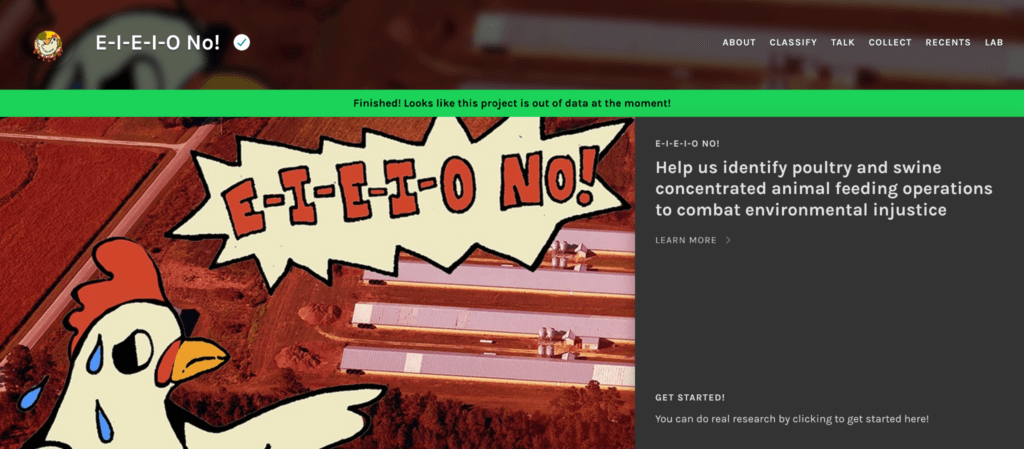
This project is a collaboration with CleanAIRE NC, the Cooper Participatory Sciences Lab at NCSU, and the Community Science and Innovation for Environmental Justice Lab at Johns Hopkins University. In just one week, 780 volunteers completed over 55k classifications, finishing two datasets of aerial imagery of two counties in Eastern NC with the densest concentrations of CAFOs in the state. New datasets will be uploaded shortly, and we hope to add future workflows to identifying different kinds of swine lagoons, biogas infrastructure, and flooding impacts.
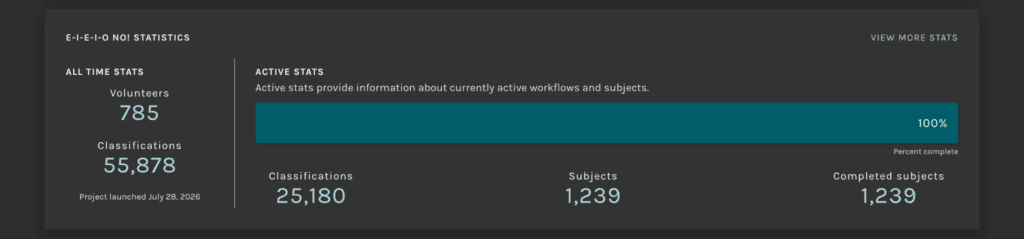
During our beta testing, some people questioned: why not use AI to analyze this data? Previous researchers have used AI to predict the locations of poultry concentrated animal feeding operations (CAFOs) (e.g., Stanford University, NC State University, the Environmental Working Group). These AI-based models can be useful for research purposes to identify CAFO locations, but in some instances the data were only 70-80% accurate or not shared publicly.
As we roll out more and more datasets, with the incredible work of our 780+ volunteers, we’re on track to prove that AI is not the fastest tool in this case. It is absolutely people.
The dominant viewpoint seems to be that the potential social good of AI justifies the harm it causes. We’ve heard this excuse before in the ways that industry and institutions frame EJ issues. We’re told that we need these factory farms to feed people, all the while Black & brown people get sick from the feces they spread. Their sickness is “justified” since other people are getting fed. We can see this echoed in excuses for coal fired power plants, PFAS pollution, policing and incarceration, large-scale development and so much more.
EIEIO No is a project that doesn’t reject modernity, but rejects harm. We’re using advanced technological tools like aerial and satellite imagery, data analytics, and massive crowdsourcing platforms, but we’re doing it without the negative ethical and environmental impacts of AI.
Our goal isn’t just to identify where these CAFOs are located, it’s about the process as much as the product.
The 780 people who have participated in the project now know about this issue, are learning about EJ, and are having active conversations on our talkboards about environmental justice, industrial agriculture, and AI use. This is building collective power. By taking the time to invite people into the project, across NC and beyond, we’re working towards building the EJ movement and educating people about it.
As NCEJN’s Research and Education team, building the EJ movement means building tools and infrastructure to get the data we have a right to know about back into the hands of the people. The logic of factory farms and AI say the same thing: “If we mechanize things, we can do it more efficiently, we can get it better and faster.”
Is that even true?
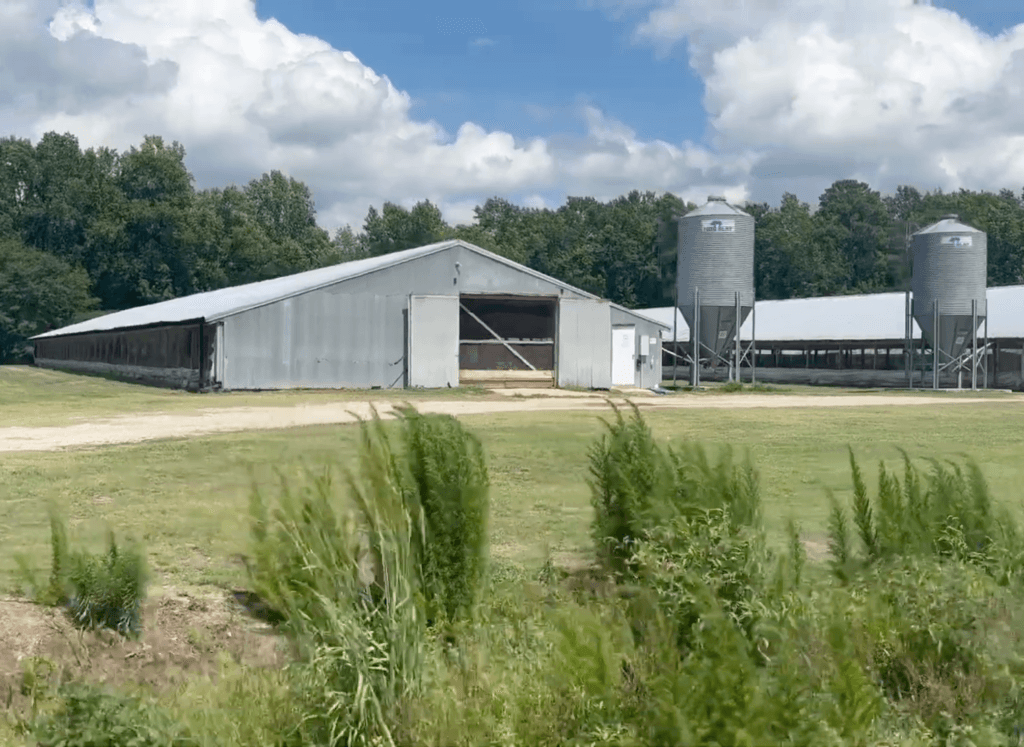
We see evidence of this in lower quality meat between factory vs. small farm raised animals. Factory farms like CAFOs encourage rampant spreading of diseases like foodborne illnesses, bird flu, Covid, and more. CAFOs are also sources of fecal matter, bacteria, and hazardous chemicals like hydrogen sulfide, ammonia, and more easily blow into people’s yards and get into the groundwater.
When people used AI tools to make the dataset from Stanford study, it still took a long time- they had to build the model, train it, click go, wait, and verify results themselves. Again, the accuracy was only 70-80%.
Pro-AI arguments claim that AI is better and faster than what we as humans can do (whether that’s data analytics, art, writing, etc.). And yet there are so many examples of AI being outright used for harm, intentionally or otherwise:
- Weeks ago, the AI in a Waymo driverless car called the cops on two of its teen passengers, drove them to a random parking lot, and waited for police to arrive.
- AI-powered automatic license plate readers and surveillance cameras like Flock are now authorized for use across NC highways and all other state roads.
- A subsidiary of the former largest swine producer in the US, Murphy Family Farms, just unveiled a small scale data center that will be used to power AI-based cybersecurity.
- Israel has been using AI tech as a murderous tool in its genocide of Palestinians, utilizing both Israeli and American built tech.
- The US Department of Defense would like to use AI for fully autonomous killing machines and mass surveillance both nationally and domestically.
- “AI systems, cloud infrastructures, and surveillance tools supplied by tech companies such as Google, Amazon, Microsoft, and Palantir have become integral to Israel’s genocidal campaign against Palestinians.” – Marwa Fatafta, 2025
We were perfectly fine before AI, and we’ll be just fine without it. We’re proud to say that we refuse to use AI tools at any part of our E-I-E-I-O No! process, from advertising graphics to image analysis to results.
While we’re still reviewing our results, it’s looking like our product is more accurate, efficient, and effective than anything AI can do. Even more importantly, it’s built with intention. We don’t need to capitulate. When we’re in good relationship with each other and use our creative energy, we can find other ways.
We can harness technology for the greater good in a way that doesn’t cause harm.
In solidarity,
Dr. Chris Lamont Brown & Corey Curtis