14 October 2026 – Rania Masri
We sent this questionnaire, several times, to every NC candidate in the 2026 elections (including city council, county commissioner, NC House and Senate, and US House and Senate; excluding sheriffs and judges.).
We received an 11% response rate. The low response rate reveals something in and of itself: the reluctance from candidates to go on the record on this critical issue.
To see if – and how – candidates in your district responded to the questionnaire, click here.
As of October 13, the dataset represents 112 candidates. These are the positions candidates chose to record in their responses, not a representative survey of every candidate running for office in North Carolina. Still, the results give us a starting point for identifying areas of agreement, understanding differences between political parties, and deciding where to focus our outreach.
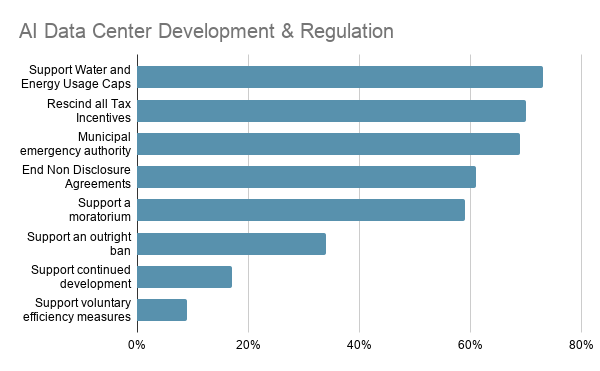
A moratorium has majority support
- 59% (68) support a temporary pause on AI data center development.
- 34% (40) support an outright ban.
Strong support for limits on data center development
Many respondents want stronger rules governing data centers, particularly when it comes to water and electricity. These were the most frequently selected data center policy positions in the questionnaire.
- 73% (85) support caps on data center water and energy use.
- 69% (80) support giving municipalities the authority to restrict data center access to water and electricity during emergencies.
There was also substantial support for removing financial incentives for developers.
- 70% (81) support rescinding all tax incentives for data center developers
- 61% (71) support ending nondisclosure agreements (NDA) with developers.
The responses also suggest that candidates are not necessarily comfortable with leaving these decisions entirely to developers.
- The 75% (85) supporting resource-use caps far outnumber the 9% (11) supporting voluntary efficiency measures instead of state or local regulation.
- 21% (24) support infrastructure investment instead of usage caps. Because candidates could select multiple answers, these positions are not necessarily mutually exclusive.
Candidates also want rules governing AI itself
The responses point toward a preference for stronger oversight. Note: A candidate may support AI regulations without supporting a moratorium on data centers.
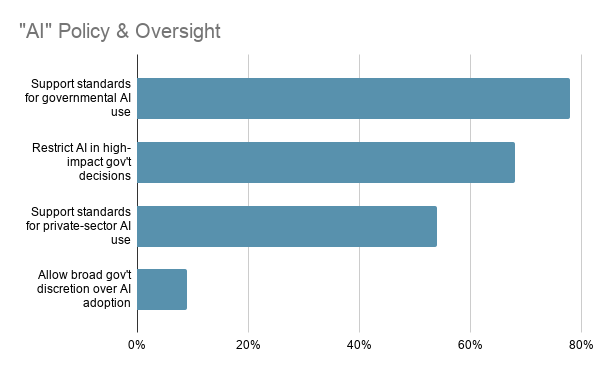
- 74% (86) support statewide standards and guidelines for government use of AI.
- 68% (79) support restrictions on AI in high-impact government decisions
- 54% (63) support statewide standards for private-sector AI.
- Only 9% (11) support allowing government agencies broad discretion to adopt AI technologies.
Differences between Democrats and Republicans
The responses show clear differences between Democratic and Republican candidates, although there is variation within both groups.
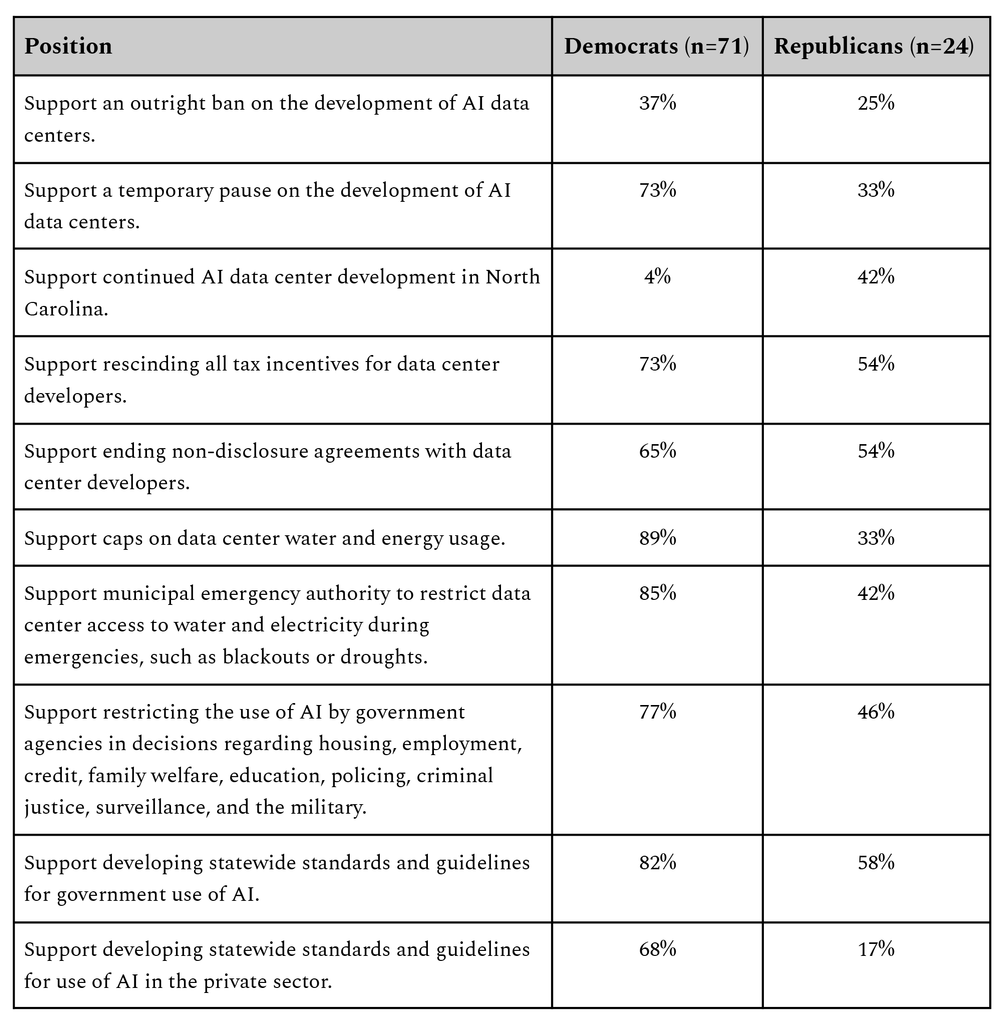
Overall, the most useful party-level finding is that the Democrats and Republicans do not have a uniform position.
For other political affiliations:
- All 4 Green submissions supported a moratorium, and water and energy caps, and 3 supported an outright ban.
- Among the 6 Unaffiliated/Independent submissions, all supported water and energy caps, while 5 supported a moratorium
- Of the 7 Libertarian candidates, 5 supported continued development and 6 supported rescinding tax incentives.
Candidates rejecting corporate campaign contributions
The questionnaire asked candidates ‘Are there any industries or specific organizations from whom you will not accept campaign contributions? Please list them here.’ The results found the following were explicitly mentioned by the candidates:
- 24% (27) state rejecting money from corporate PACs
- 8% (9) state rejecting money from American Israeli PAC (AIPAC)
- 7% (8) state rejecting money from Duke Energy
Campaign financing can reveal whether candidates are willing to set boundaries around corporate influence. It is important to distinguish what candidates actually promised from what they may actually do. The following are the candidates who said they would not take funds from Duke Energy and/or AIPAC.

Interest in further engagement with the NC AI Data Center Accountability Network
The questionnaire also asked whether candidates were interested in receiving information or engaging with the Network. The vast majority said yes.
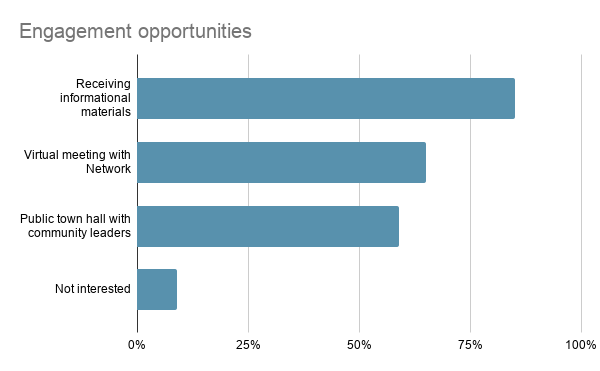
Ninety-nine submissions (85%) expressed interest in receiving informational materials. Seventy-five (65%) indicated interest in a virtual meeting with Network members, and 69 (59%) indicated interest in a public town hall with community leaders. Eleven (9%) selected that they were not interested in further information or engagement at that time.