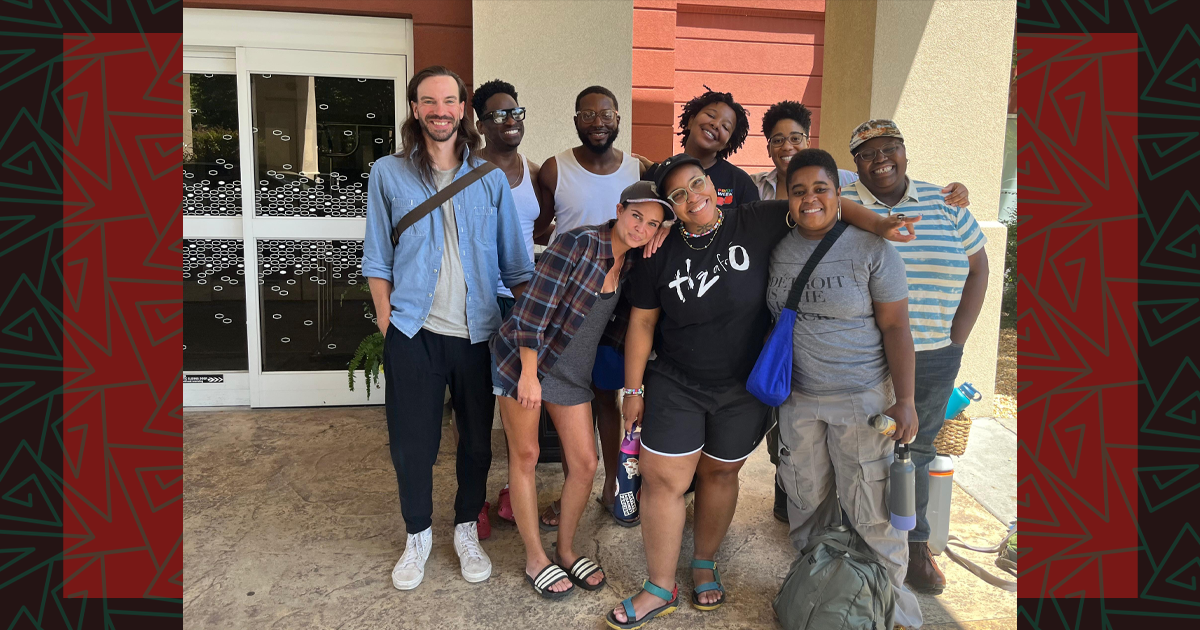
Danielle Purifoy (JD, PhD), is a former NCEJN Board Member, a UNC-CH Assistant Professor, Dept. of Geography & The Environment, and an author of so many articles relevant to our work like this and more
Dear NCEJN,
I write to share with you a special event/highlight from last summer, attended by some NCEJN staff and many associates and friends. The first Durham Black Ecologies Field School was a two-day exploration of the Black and Indigenous histories of the Eno River watershed and neighboring waters, including what two elders of Hayti called Burton Creek. A crew of organizers, artists, farmers, and scholars from Durham and Greensboro and attendees connected to Virginia, Maryland, Louisiana, Mississippi, New Jersey, Pennsylvania, Colorado, and Wisconsin gathered in the woods and on the water and at Stagville Plantation/Horton Grove and the historic Black community of Hayti and at the Earthseed Land Collective. Our teachers were Vivette Jeffries-Logan, Asia Dorsey, Aya Shabu, Teli Shabu, Kayla Cyrus, Georie Bryant, JuJu Holton and Quisha Mallette, and Justin Robinson. We sang and ate and paddled and walked and played and learned so much from each other. As an educator during this particularly dangerous era of attempted knowledge erasures, this feels like necessary work. I believe these community-based forms of public education have a major role to play in our collective pursuit of environmental justice.
Our work together was co-sponsored by the Global Black Ecologies Lab at Rutgers University, the Spencer Foundation, Dumbarton Oaks, and UNC Chapel Hill.
We are currently in the process of building resources to launch a more permanent field school effort in the Triangle region and larger state. Please be in touch if you have questions or are interested in supporting the work!
(Email: danielle.purifoy@gmail.com)
Here are some highlights from our trip together. Jona Alexander, a Philadelphia based filmmaker and member of the Black Ecologies Lab at Rutgers University, captured our time together in this short film.
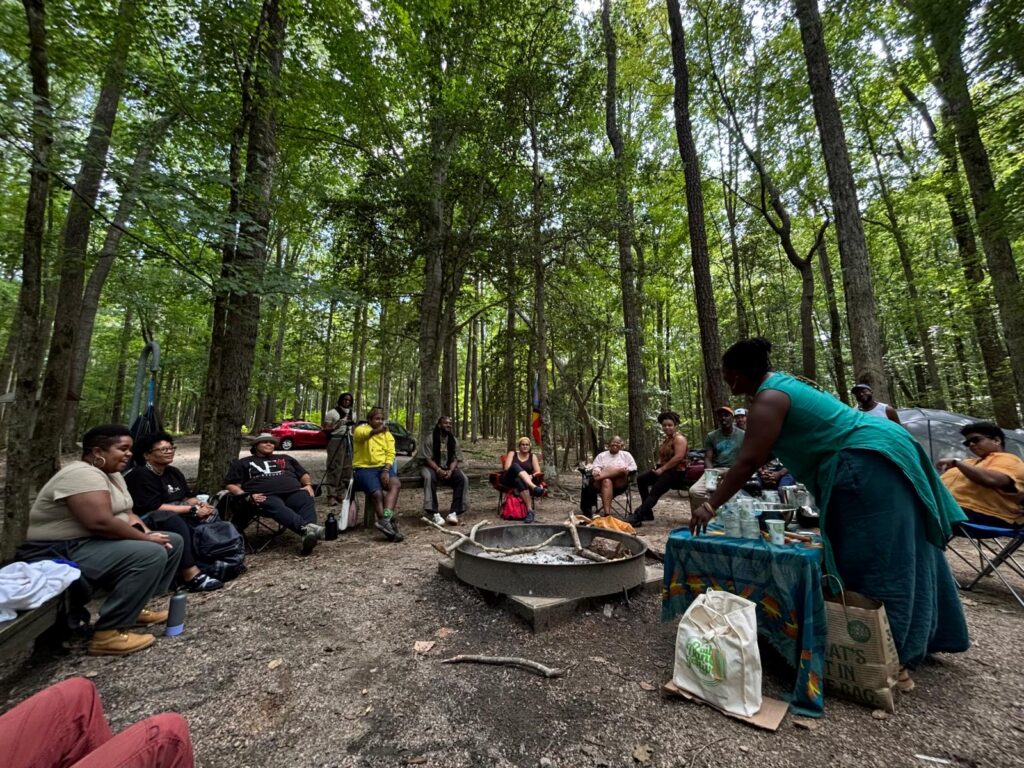
Grounding/Intro Circle at Eno River Confluence, Hillsborough NC. Our first facilitator, Vivette Jeffries-Logan, who is a member of the Occaneechi Band of the Saponi Nation and a consultant for groups working on collaborative land projects and other related endeavors, welcomed participants to the Eno River watershed and conducted a grounding exercise in which she invited participants to introduce themselves through the places where everyone was from and an object that was of personal significance to them.
Whistlestop tour of Hayti neighborhood, Durham NC. Aya Shabu, along with Teli Shabu and Kayla Cyrus, conducted a whistlestop tour of the Hayti neighborhood, one of several historically Black communities in Durham. Burton Creek runs through Hayti, and in addition to the other sites, including the historic Lincoln Hospital, the Scarborough Funeral home, the Algonquin Tennis Club, and the Stanford Warren Library, the participants visited what remains of the creek and heard from two elders from the neighborhood about spending their childhoods playing at the creek. Burton Creek is now threatened by ongoing pollution from Brenntag Mid-South.
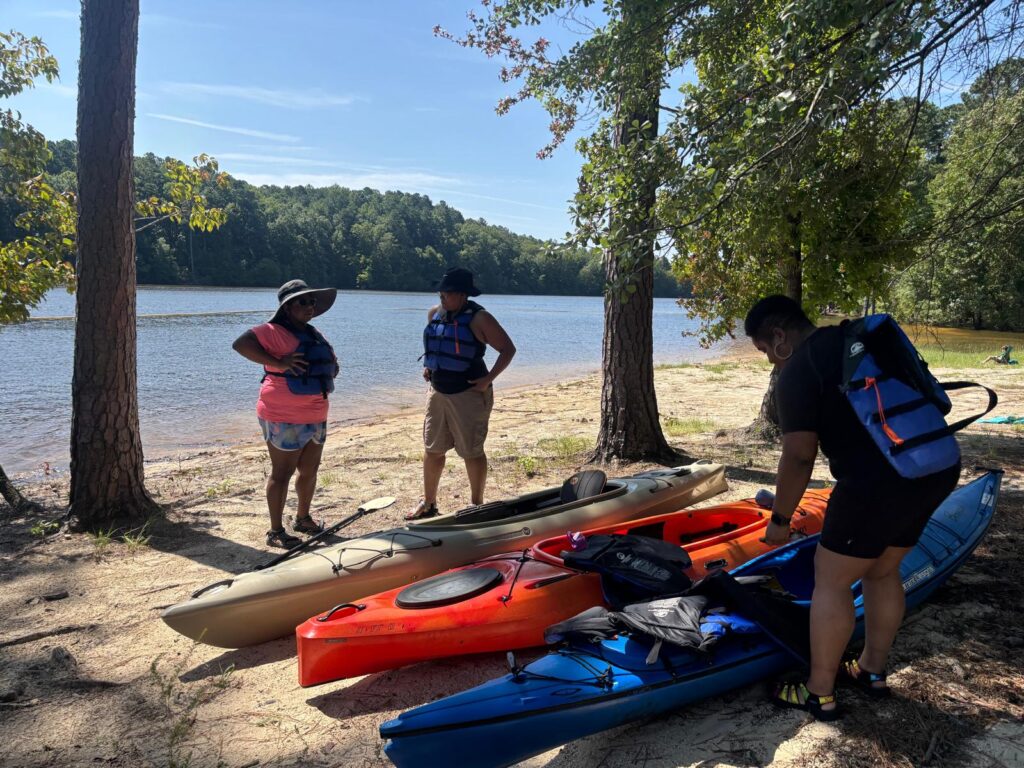
Suiting up for kayaking on Falls Lake
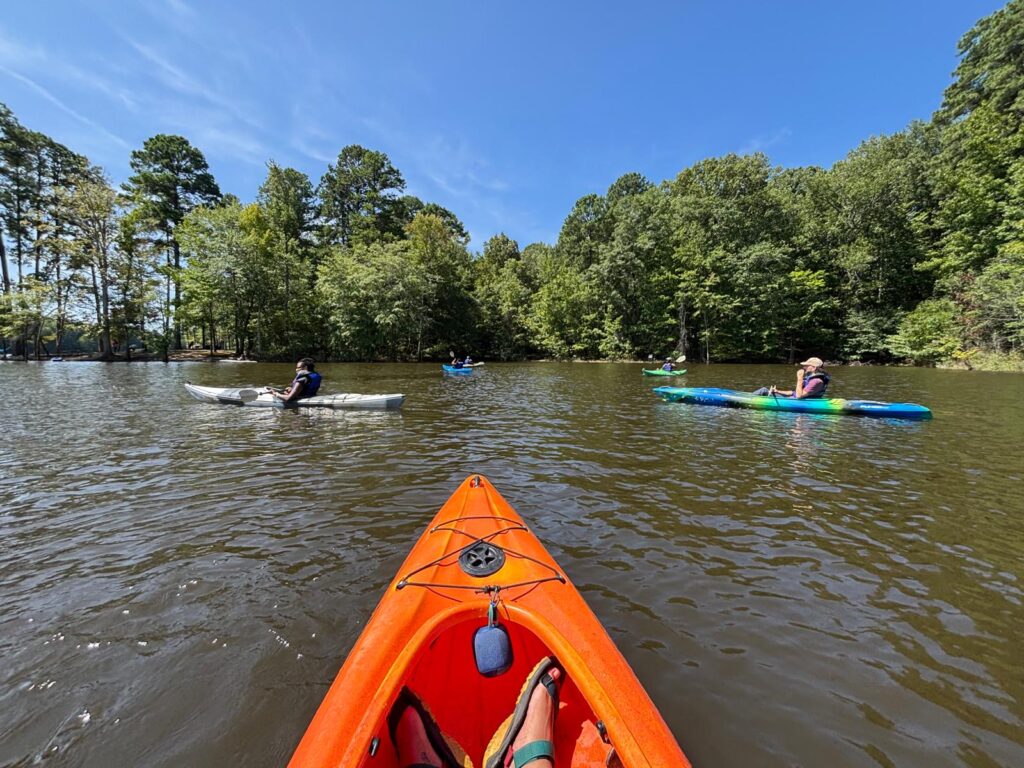
Field Day at Falls Lake, Durham NC. JuJu Holton and Quisha Mallette led our field day as part of H2Afro, an organization devoted to supporting Black people in swimming, water sports, and developing healthy relationships to water rooted in history and healing modalities instead of fear. After learning about the history of Falls Lake and the upcoming efforts to document more of the histories of the communities/gravesites that were submerged during the Lake’s construction, participants went on a kayaking exploration of the Lake.
Visit to Stagville and Horton Grove, Durham, NC. Georie Bryant, a farmer, agricultural consultant, and a member of the Stagville Descendants Council led one of our final sessions. Stagville was one of the largest plantations in North Carolina and was integral to the formation of Durham as a post-Civil War city. Many of Durham’s multi-generational Black residents are descendants of people who were enslaved at Stagville. At the Stagville visitors center, Bryant gave a lecture about the Afro-Indigenous, American Indigenous, and European peoples who converged in what became Durham and Orange Counties as a way of helping us to understand the confluence of cultures, agricultural traditions, and social structures that shaped the region. Bryant ended the visit with a walking tour of Horton Grove, the residential quarters of the enslaved at Stagville, which has several remaining buildings intact, including a large barn with unique historic architecture.
Huge thanks to JT Roane, Teona Williams, and the Global Black Ecologies Lab for inviting me into community a few years ago. To our incredible Durham team—JuJu Holton, Sarah Long, and Quisha Mallette—for all their support in manifesting this school into a space for connection and fun and for putting up with my chaotic/neurotic ass. To Thaïsa Way and Dumbarton Oaks for enthusiasm and additional funding. To all the teachers who were so generous and brilliant and who connected places and issues with no coordination/planning. To WD Hill Community Center for opening their doors to welcome us to Hayti. To Hunter Longest and Barbara Taylor in the UNC Dept of Geography and Environment, for guiding me through the mad logistics of UNC’s bureaucracy. To Jona Alexander, for respectfully and beautifully documenting it all.
And to the Eno, who flooded her banks in July, demanding that we get into right relationship with her. A call to action.
This is just the beginning… 🙏🏾