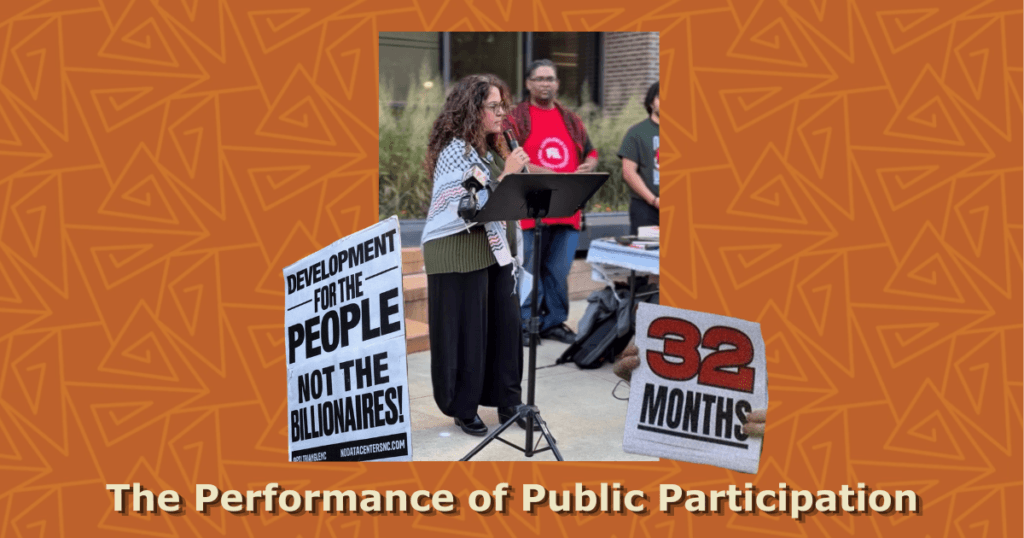
NCEJN was present at the press conference and public hearing in Richmond County on July 30th. Find below, comments from Dr. Rania Masri, Jasmine Washington (SELC), Michelle (Meech) Carter (NCLCV), and Rev. Mac Legerton. More than 150 people were at the hearing, and 75% of the comments were given by community members.
Comment from Dr. Rania Masri, NCEJN
Good evening. My name is Dr. Rania Masri, co director of the North Carolina Environmental Justice Network.
I am here – because what happens in Richmond County impacts us all in NC, and, harm to one in NC is harm to us all
Based on the clear science, based on a framework of justice, I ask the DAQ to deny not only the separation of these permits, but to also deny both these permits for the 649 diesel generators.
Deny these permits as they stand.
Why?
- To protect the air quality of the residents.
These diesel generators would release additional pollutants and toxins that cause asthma, cancer, heart attacks, and cognitive decline. According to published studies, In 4 years, air pollution from data centers alone could cause an additional 600,000 asthma cases annually in the US and an estimated 1,300 premature deaths. Is this what we want to bring to this county?
These diesel generators will make it difficult for residents in Richmond County to breathe.
Amazon’s own report concluded that Richmond County is “within the two least healthy ranges for the state” in terms of health and well-being. The Centers for Disease Control and Prevention described the census tract where the facility is located as “highly burdened” by pollution. Do you want to burden this county even further, a county that has already lost ½ its hospitals – to simply benefit the billionaires of Amazon and Duke Energy, rather than the residents of this county and this state?
Annual public health costs from data-center-related energy use could reach $5.7B–$9.2B.
- Deny these permits also to protect the validity of DEQ and DAQ itself. Amazon has already started construction – presuming these permits will be granted exactly as Amazon and Duke have applied. The ongoing construction is a significant violation of federal and state law. Deny these permits for this reason alone.
All this is already known. And it isn’t even the full extent of the harm of these diesel generators. These generators will also pollute the water, create harmful noise pollution, and significantly reduce the living standards of the residents in Richmond County and beyond.
DEQ is charged with “Providing science-based environmental stewardship for the health and prosperity of ALL North Carolinians.” Follow the science – not the money..
DEQ is charged with the protection of the environment. Say no to the permits for this toxic, extractive industry. Say no to both the permits. Say yes to the science and yes to public health.
Comment from Attorney Jasmine Washington, SELC
Good evening,
DAQ must deny the applications and draft permits to Amazon and Duke Energy. These draft permits incorrectly categorize the 600+ generators that will power Amazon’s data as two separate synthetic minor. It is clear that these co-located generators are under common control and for the same facility. Therefore, DAQ must require Amazon to submit a new application for a single, major stationary source permit.
DAQ must act to Prevent Significant Deterioration of air quality in the communities around Amazon’s proposed facility.
Amazon and Duke seek to install hundreds of diesel-powered generators in a community that is already surrounded by pollution and faces many health disparities.
14% of the people in the town of Hamlet are disabled, while the CDC has identified the Dobbins Heights area as highly vulnerable with elevated asthma rates. Richmond County has severe healthcare shortages, higher-than-average heart disease and cancer rates, and lower life expectancy. The surrounding area also includes disproportionately high numbers of young children and older adults. These populations are especially susceptible to negative health outcomes from acute and long-term exposure to air pollution from diesel generators.
These communities are already burdened air pollution from several existing operations. There are over a dozen air polluting facilities within 3 miles of the town of Hamlet and Dobbins Heights, and Amazon seeks to be added to that list.
Under the Clean Air Act, DAQ has a responsibility to ensure compliance with National Ambient Air Quality Standards (“NAAQS”) and to investigate areas where there is a potential risk of NAAQS exceedances. Yet, here, the nearest regulator air quality monitor is 30 miles away.
For this permitting action, the vulnerabilities identified in DAQ’s Community Profiles, along with the number of other nearby polluting industries and lack of regulatory air quality monitors, more than warrant site-specific monitoring around Amazon’s proposed facility.
Throughout the draft permits, there are defects in emissions calculations, improper exemptions for operational limits, monitoring, recordkeeping and reporting, and insufficient modeling.
There is no excuse for cutting corners in this permitting action. Enough private conversations and deals have happened without public notice to lore Amazon’s pollution operation to this community. While economic impacts are beyond the scope of this permit review, I implore that DAQ should not yield to industry pressure or rely on unsupported claims to relax regulator standards in this permitting process. Especially, given the substantial public investment, from the county and state, already made in Amazon, for speculative economic benefit, DAQ must ensure those investments do not come at the cost of human health or environmental harm.
DEQ should reject Amazon and Duke Energy’s attempt to artificially segregate emissions from the same operation.
Comment from Michelle (Meech) Carter, NC League of Conservation Voters
Re: Amazon and Duke Energy Draft Air Quality Permits (Amazon.25A and DukeRichmond.26C)
Good evening. My name is Meech Carter, and I am the director of Clean Energy Campaigns at the North Carolina League of Conservation Voters.
First, please accept my small thanks for pushing back against Amazon’s initial request to prevent the public from viewing the contents of this permit. According to DAQ records, Amazon requested confidentiality for this facility, which is clearly an attempt to hide detrimental information from Richmond County community members.
Amazon and Duke Energy say their two sets of generators are separate projects, which lets them follow easier pollution rules and avoid using the strongest pollution controls. Considering Amazon is ALREADY BUILDING THIS FACILITY just down the road, they clearly have no care for air quality or for the community they are entering.
These permits show an intentional avoidance of stronger air permitting guidelines by how these generators are divided between Duke and Amazon. One permit showed emissions limits of 249.9 tons of NOx, CO, and VOCs. Note that this is JUST below the threshold of 250 tons per year required to trigger a stronger permit.
These applications ask for 1.7 GW of potential generation at full load, which is roughly equivalent to two entire gas-fired power plants.
In these permit applications, DAQ is allowing corporations to scheme for their own financial benefit while ignoring the severe impacts coming to a community that is already struggling.
In page 25 of DAQ’s permit review for Duke Energy, Duke states that this generation is “in support of electrical demands for […] the grid”, yet in the same paragraph states that “these engines will be dedicated in use to a single customer.”
These generators are paid for by Amazon, will be turned on and off at the request of Amazon, and will be placed on site for the needs of Amazon. These generators would not even be needed if Amazon wasn’t coming to town.
Therefore, we believe DAQ’s assessment that these generators are not under common control is in error, and these generators should be in ONE permit application. Both of these projects should be resubmitted and considered jointly under Title V major source requirements.
Computer servers don’t breathe this air, and neither do the Amazon employees in Seattle OR the Duke Energy employees in Charlotte who submitted this application.
I’ve asked you this before on a pipeline and I’ll do it again. I’m asking DAQ employees to be brave, to follow state and federal law, and to do the right thing for our air, for our communities, and for our future and deny these permit applications.
Comment from Reverend Mac Legerton, Robeson County Cooperative for Sustainable Development
I am Rev. Mac Legerton, Co-Director of the Robeson County Cooperative for Sustainable Development. I’ve been engaged in civic life and community ministry, including environmental protection and promotion, for over 45 years. Over 30 years ago, I stood in this very courthouse more than once and testified before our state officials regarding the dangers of citing a massive low level radioactive dump near Hamlet. We researched and recommended a better waste management approach, safety plan, and a more suitable site elsewhere that was approved. This county and its people were spared from a major form of harmful underdevelopment.
Amazon and Duke Energy officials, I humbly suggest that you withdraw these two air quality permit requests that apply for two minor source permits for hazardous waste pollutants and apply for one major source, air quality permit for them. If these over 600 diesel fuel powered generators look similar, sound similar, smell the same, and release the same toxic fumes, they are the same. You cannot split a single hair. We humans are good at mincing words, justifying our positions and actions in deceptive ways. The difference between reason and treason is just one letter. We rural people don’t have wool wigs to wear that can be pulled over our eyes to obscure our vision and trick us. Have integrity and be responsible; withdraw your two minor source permit requests and re-apply for a major source permit for hazardous waste pollutant emissions.
To the staff of the NC Department of Environmental Quality if Amazon and Duke Energy officials won’t withdraw this improper permit, you have the responsibility to deny it. The over 600 combined generators meet the definition and threshold of requiring a major source permit. Lean on your backbone and fulfill your mission that, in spite of politics, protect environmental and public health and defend our people and the places we live against undue harm. Demonstrate your integrity and character and don’t bend to the political wind.
Why has construction of the proposed data center been allowed to begin prior to receiving all necessary permits to operate and resolution of litigation challenges in the process. If you have the power to halt or recommend that construction stop prior to all permits being received, I suggest that you do so. In my opinion, this practice and your acceptance is, in the least, a breach of public trust.
Until data centers are designed on a smaller more responsible scale and meet all the criteria of sustainability, they are not good neighbors for any community around the world, particularly communities like the Hamlet area that are already overburdened with polluters, no matter how they are wrapped, justified, and marketed. Thank you.